
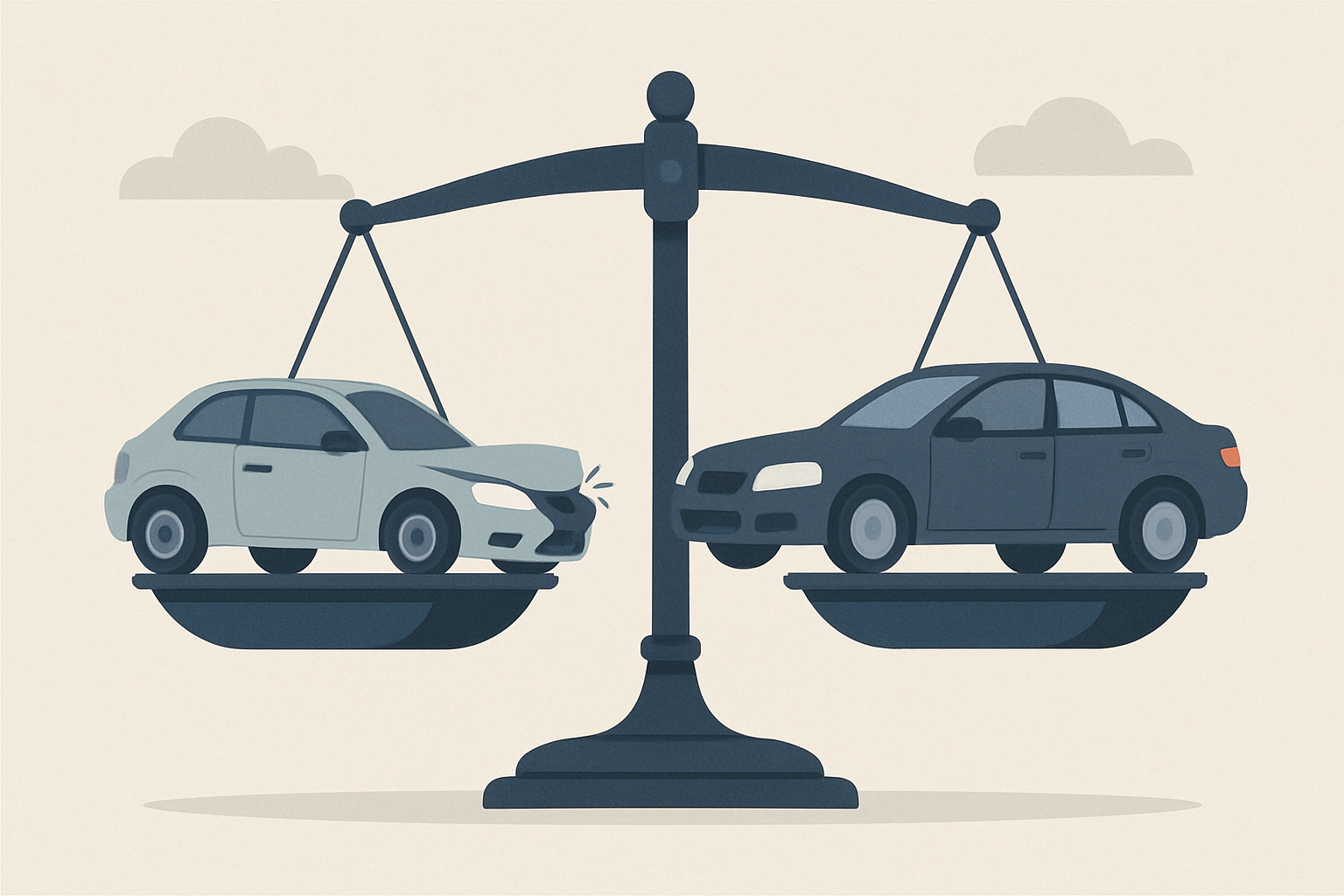
Comparative fault decides how much you can recover when you share blame for a crash. Your state uses one of four systems, and the differences are huge — in five U.S. jurisdictions, being just 1% at fault can bar you from recovering anything (Justia, 2026).

Key Takeaways
- Comparative fault reduces your payout by your share of blame.
- The U.S. uses four systems: pure comparative, 50% bar, 51% bar, and contributory.
- In Alabama, Maryland, North Carolina, Virginia, and D.C., 1% fault bars recovery.
- The gap between 50% and 51% at fault can mean the difference between a payout and zero.
What Does Comparative Fault Mean?
Comparative fault (or comparative negligence) is the legal rule that divides blame between drivers and reduces your compensation by your share. If you’re 30% at fault and your damages are $100,000, you’d typically recover $70,000. The exact rules depend on your state.
What Are the Four Fault Systems?
U.S. states use one of four negligence systems (FindLaw, 2026):
- Pure comparative: you recover even if 99% at fault, minus your share (e.g., California, New York)
- Modified — 50% bar: no recovery if you’re 50% or more at fault (e.g., Georgia, Colorado)
- Modified — 51% bar: no recovery if you’re more than 50% at fault — the most common rule (e.g., Texas, Illinois)
- Contributory negligence: 1% fault bars recovery entirely (Alabama, Maryland, North Carolina, Virginia, D.C.)
How Does the Math Work?
In every comparative system, your recovery drops by your fault percentage. In Texas, if you’re 40% responsible, you can recover 60% of your damages. The systems only diverge at the threshold: in a 50%-bar state, being exactly 50% at fault means zero; in a 51%-bar state, 50% still pays. One percentage point can erase your entire claim.
Why Florida’s 2023 Change Matters
Florida shows how these rules shift. In March 2023, House Bill 837 replaced Florida’s pure comparative system with a modified 51% bar — now, a driver more than 50% at fault recovers nothing. This is why you should always confirm your state’s current rule rather than rely on older guides.
Who Decides Your Fault Percentage?
Insurers make the first determination when reviewing the crash. Because so much money rides on the percentage, they often try to shift more blame onto you to pay less. If the parties can’t agree, a judge or jury decides based on the evidence. Strong documentation of the other driver’s fault is your best protection.
Is the insurer blaming you to cut your payout? A free attorney review can challenge the fault split.
How Can You Protect Yourself Under Comparative Fault?
Since your fault percentage directly cuts your payout, protecting it starts at the scene. Never admit fault, even casually, and gather evidence that supports your version — photos, witness contacts, and a dashcam clip if you have one. Every point of fault shifted onto you can cost real money.
When the insurer proposes a fault split, treat it as a starting position, not a verdict. If you disagree, submit contradicting evidence and ask for a review. In higher-value cases, an attorney can be worth far more than their fee by arguing your fault percentage down.
Why Does Your State’s Fault Rule Matter So Much?
The same crash can produce wildly different outcomes depending on your state’s rule. Under pure comparative negligence, you can recover even if you’re 99% at fault (minus your share). Under modified comparative negligence, you recover only if you’re below 50% or 51% at fault. And in a few strict contributory-negligence states, being even 1% at fault bars recovery entirely.
Knowing which rule applies where you live tells you how hard to fight over the fault percentage — and how much is genuinely at stake in that negotiation.
How Do You Prove You Were Less at Fault?
Evidence wins fault disputes. The strongest proof includes the police report, scene and damage photos, independent witness statements, and any dashcam footage. Traffic laws matter too — showing the other driver violated a rule (running a light, illegal turn) shifts fault toward them.
Present this evidence clearly when you dispute a fault split, and ask the insurer to justify its allocation. Because each percentage point can move thousands of dollars, a well-documented challenge is almost always worth the effort.
Frequently Asked Questions
Which states use contributory negligence?
Only five jurisdictions use the strict contributory negligence rule: Alabama, Maryland, North Carolina, Virginia, and Washington, D.C. In these places, being even 1% at fault can bar you from recovering any compensation, making clear fault evidence essential.
What’s the difference between the 50% and 51% bar?
In a 50% bar state, you recover nothing if you’re 50% or more at fault. In a 51% bar state, you can be exactly 50% at fault and still recover. That single percentage point is the difference between a reduced payout and zero.
Can I recover if I was partly at fault?
In most states, yes — your award is just reduced by your share of blame. The exception is the five contributory-negligence jurisdictions, where any fault can bar recovery. Check your state’s rule, since it determines whether partial fault costs you some money or all of it.
Bottom line: comparative fault means the percentage assigned to you is money, plain and simple. Learn your state’s rule, protect yourself at the scene, and never accept an unfair fault split without challenging it with evidence. In higher-value cases, the fault percentage is usually the fight worth having.
Conclusion
Comparative fault can quietly decide whether you recover full damages, partial, or nothing at all. Because the rules vary so much — and change over time, as Florida shows — confirm your state’s current system and document the other driver’s fault carefully. When fault is disputed, a free legal consultation can protect your recovery.
Disclaimer: This article is for general informational purposes only and does not constitute legal advice. State fault rules vary and change over time. Consult a licensed attorney in your jurisdiction about your specific situation.